

It’s not just “Small.” eBay wants fashion resellers to use standard Size item specific values like S, M, L, and XL so listings can rank correctly in size-based searches.
Fashion resellers, this is one of those eBay updates that sounds small until you realize how directly it connects to search visibility.
eBay announced that it is standardizing Size values in Apparel and Footwear categories in 2026. In plain reseller terms, that means sellers need to stop typing custom size words like Small, Medium, Women’s Small, Size Large, or Ladies M in the Size item specific when eBay expects a standard value like S, M, L, or XL.
This does not mean you can never use words like “Women’s,” “Small,” “Petite,” or “Size S” in your listing title.
Your title is still for buyer-friendly search language.
This update is about the Size field / Size item specific inside the listing details. That field needs to use the standard value eBay recognizes for the category so eBay can match your listing to buyers filtering or searching by size.
eBay says non-standard size values can reduce search recall, recommendation eligibility, and buyer confidence. eBay also says non-compliant values are not indexed by search, which means buyers may not find the sizes they are searching for when listings use size values eBay does not recognize. (eBay Developers)
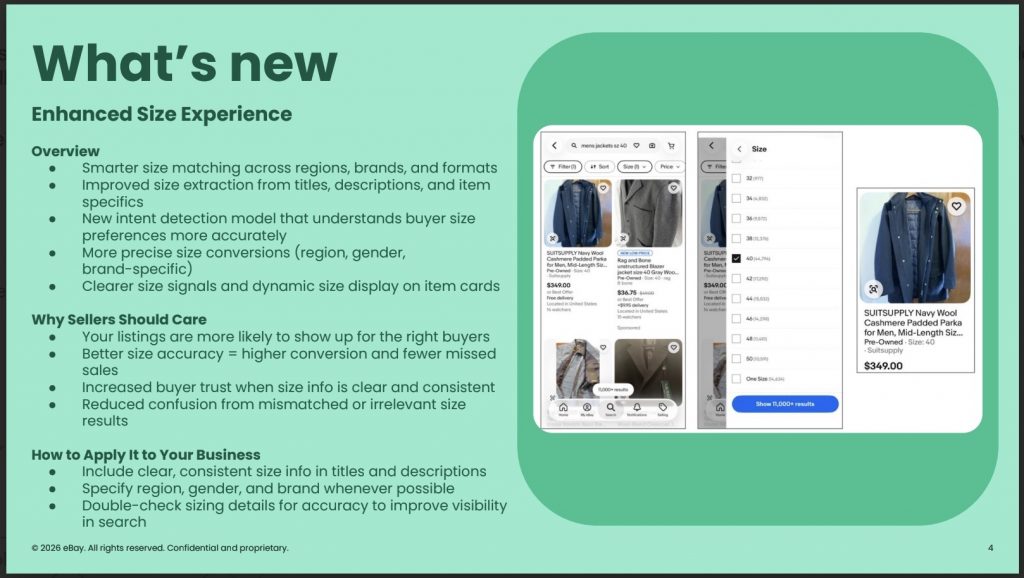
Starting in June 2026, eBay will begin automatically adjusting some non-standard size values. For example, if Small is provided as the Size value, eBay says it will automatically adjust that value to S. Starting in July 2026, eBay will get stricter about missing, non-standard, or non-compliant Size values. (eBay Developers)
This is about visibility, ranking, and whether the right buyer can find your fashion listing when they search or filter by size.
courtesy of eBay
What Resellers Are Doing Now That Will Hurt Visibility After July 2026
A lot of resellers have gotten used to typing size information however it makes sense to them.
Maybe you type this in the Size field:
Women’s Small
Size Medium
Ladies Large
Men’s XL
Small / Medium
See Measurements
Tag Missing — Fits Like Medium
Those may make sense to a human buyer, but eBay is moving toward standard Size values. That means the Size item specific should be clean, simple, and selected from what eBay recognizes for that category.
Think of it this way:
Size means size only.
Not gender.
Not department.
Not the clothing type.
Not a sentence.
Not your measurement notes.
If the item is a women’s small blouse, the Size field should usually be something simple like:
S
Not:
Women’s Small Blouse
Size Small
Ladies S
Small Women’s
The rest of that information belongs in other parts of the listing, like the title, department, size type, description, and photos.
What Should Resellers Put in the eBay Size Field?
Use the actual Size value eBay recognizes for that category.
| Instead of typing this in the Size field | Use this kind of Size value |
| Small | S |
| Medium | M |
| Large | L |
| Extra Large | XL |
| Women’s Small | S |
| Ladies Medium | M |
| Men’s Large | L |
| Size 8 | 8 |
| Women’s Shoe Size 8.5 | 8.5 |
| Size 32 x 30 Jeans | 32×30, if that is the accepted eBay option |
The exact allowed Size value can vary depending on the category. A dress, a pair of jeans, a pair of shoes, a bra, a jacket, and kids’ clothing may not all use the same size options.
So the safest rule is this:
Use the Size option eBay gives you. Do not invent your own version in the Size field.
Should You Type the Word “Size” in the Size Field?
No.
Do not type this in the Size field:
Size Small
Size Medium
Size 8
Size XL
The field is already called Size. You do not need to repeat the word.
Use:
S
M
8
XL
This seems like a tiny detail, but tiny listing details are exactly what eBay is trying to standardize.
Should You Put “Women’s” or “Men’s” in the Size Field?
Usually, no.
“Women’s,” “Men’s,” “Girls,” “Boys,” and “Unisex” belong in the Department field, not the Size field.
A stronger listing setup would look like this:
| Field | Example |
| Department | Women |
| Type | Sweater |
| Size | S |
A less optimized Size field would look like this:
| Field | Example |
| Size | Women’s Small Sweater |
The buyer may understand what you mean, but eBay may not treat that as a clean standardized Size value.
Where Should Petite, Plus, Juniors, or Maternity Go?
Do not stuff those words into the Size field either.
Use the correct item specifics when eBay gives them to you.
| Information | Better place to put it |
| Women’s, Men’s, Girls, Boys, Unisex | Department |
| Petite, Plus, Juniors, Maternity, Big & Tall | Size Type, when available |
| Shirt, dress, jeans, boots, sneakers | Type or category |
| S, M, L, XL, 8, 10, 32×30, 8.5 | Size |
| Bust, waist, inseam, rise, length | Description and photos |
For example, if you are listing a women’s petite sweater, the listing should not rely on the Size field to explain everything.
Better:
| Field | Entry |
| Department | Women |
| Size Type | Petite |
| Size | S or the exact eBay-approved petite size option |
| Type | Sweater |
Not:
| Field | Entry |
| Size | Women’s Petite Small Sweater |
The more each field does its own job, the easier it is for eBay to understand your listing.
What About the Listing Title?
This is important: your title is different from the Size item specific.
In your listing title, you can still write naturally for buyers. Titles are for buyer-friendly search language, brand, item type, style, and readable details.
For example, these titles still make sense:
J.Crew Women’s Wool Sweater Size S Petite Blue
Nike Men’s Running Shoes Size 10.5 Black
Madewell Women’s Jeans Size 28 High Rise Straight
Anthropologie Women’s Small Floral Blouse
That is fine because the title is meant to help shoppers understand the item.
The change is about the Size field, not removing helpful size words from your title.
So the rule is:
Use buyer-friendly wording in the title. Use standardized values in the Size item specific.
A title can say:
Women’s Small Blouse
But the Size field should use the standard Size value eBay recognizes, such as:
S
That distinction matters.
Why eBay Size Fields Matter for Search Visibility
When buyers shop for clothing and shoes, they often filter by size.
If your listing has a non-standard Size value, eBay may not understand it the same way a buyer does. That means your item can be listed, but still lose visibility for the buyer searching for that exact size.
For resellers, that is a serious problem.
You can have great photos, a good brand, a fair price, and fast shipping — but if eBay does not understand your Size field, your listing will not perform the way it should in size-based searches.
A buyer searching for a size S top needs eBay to understand that your item is size S. If your Size field says Women’s Small Blouse, Size Small, or Ladies S, eBay may not match that listing correctly to the buyer’s size search.
This is about being found.
What Changes in June 2026?
Starting in June 2026, eBay says it will begin automatically adjusting some non-standard Size values to standard values across marketplaces. For example, if a seller enters Small as the Size value, eBay says it will automatically adjust it to S. (eBay Developers)
That might sound helpful, but resellers should not depend on eBay to clean everything up for them.
If eBay recognizes the Size value, it may adjust it. If eBay does not recognize the Size value, the listing flow may trigger a warning. (eBay Developers)
In other words, June is the warning period.
July is when Size fields need to be treated as a visibility requirement, not an optional listing detail.
What Changes in July 2026?
Starting in July 2026, eBay will get stricter about missing, non-standard, or non-compliant Size values in fashion listings.
For resellers, the main issue is visibility in buyer searches and size filters.
If eBay does not recognize the Size value in your listing, your item will not rank the way it should when buyers search or filter by size. That means the listing may exist, but the right buyer may never see it.
This is why the Size field matters.
The Size field tells eBay where your listing belongs in buyer searches. If that field is filled with custom wording instead of a standard Size value, eBay has a harder time matching your item to the buyer who is searching for that size.
Do Not Forget Condition
Size is the big topic here, but condition matters too.
eBay says Size and Condition, which were previously optional in some fashion categories, will become required fields for all new listings in fashion categories. eBay also says current listings with missing condition information will be put on hold until the issue is addressed. (eBay Developers)
So while you are updating Size fields, check condition too.
Make sure your listings clearly show whether the item is pre-owned, new with tags, new without tags, or whatever condition option eBay provides for that category.
What Fashion Resellers Should Fix Before July 2026
Go through your active fashion listings, drafts, templates, and crosslisting habits.
Look for Size fields that say things like:
Small
Medium
Large
Extra Large
Women’s Small
Men’s Medium
Ladies Large
Petite Small
Curvy Medium
Men’s Long
Size XL
XLarge
One Size Fits All
See Measurements
No Tag
Unknown
Fits Like Medium
Some of these may have a valid eBay option. Some may need to be moved into the description. Some may need seller judgment.
But the Size field itself should be as clean and standard as possible.
What If the Tag Is Missing?
This is where resellers need to be careful.
If the size tag is missing, do not use the Size field as a long explanation.
Do not put:
Tag Missing Fits Like Medium See Measurements
Instead, choose the most accurate Size option only if you can support it, and explain the details in the description.
For example:
Size field: M
Description: Size tag is missing. Estimated women’s size M based on measurements. Please review measurements before purchasing.
And include clear measurements in the photos or description.
The Size field should stay clean. The explanation belongs in the description.
What If the Item Is Between Sizes?
Do not invent a custom Size value unless eBay offers that exact option.
If eBay gives you a valid option like S/M, use it only if it accurately describes the item and appears as an accepted value for that category.
If not, choose the closest accurate standard Size value and use your description to explain the fit.
For example:
Tagged size S. Relaxed fit. Please see bust and length measurements.
That is better than stuffing the Size field with:
Small Medium Oversized Fit
The Reseller Rule to Remember
Here is the easiest way to explain the change:
Your eBay Size field should be a standardized value, not a custom note.
Use:
S, M, L, XL, 8, 10, 32×30, 8.5
Do not use:
Women’s Small, Size Medium, Ladies Large, Fits Like M, See Measurements
Put the extra details where they belong:
Department: Women, Men, Girls, Boys, Unisex
Size Type: Petite, Plus, Juniors, Maternity, Big & Tall, when available
Description: measurements, fit notes, missing tag explanations
Title: buyer-friendly wording
FAQ: eBay’s 2026 Fashion Size Rules for Resellers
What is eBay changing for fashion sizes in 2026?
eBay is standardizing the Size item specific in Apparel and Footwear categories. Resellers should use the standard Size values eBay recognizes instead of typing custom size text in the Size field.
Does this change apply to my eBay title?
No. This change is about the Size item specific / Size field, not the listing title. Your title can still use buyer-friendly wording like Women’s Small Blouse or Men’s XL Jacket. The Size field should use the standard value eBay recognizes, such as S or XL.
Why does this matter for resellers?
Because non-standard Size values are not indexed correctly in search. If eBay does not recognize your Size field, buyers searching or filtering by size may not find your listing.
Should I type “Small” or “S” in the eBay Size field?
Use the standard value eBay recognizes. eBay gave the example that Small will be adjusted to S, so resellers should build the habit of using S instead of typing Small in the Size field.
What size values should resellers stop typing in the Size field?
Resellers should stop using custom size entries in the Size field, such as Small, Medium, Large, Women’s Small, Size Medium, Ladies Large, Men’s XL, Petite Small, Curvy Medium, Men’s Long, See Measurements, or Fits Like Medium.
The Size field should use the standard value eBay recognizes for that Apparel or Footwear category.
Should “Women’s,” “Men’s,” “Petite,” or “Plus” go in the Size field?
Usually, no. The Size field should be for the size value only. Put details like Women’s, Men’s, Petite, Plus, Curvy, or Long in the correct eBay item specific when available, not as custom text in the Size field.
What happens in June 2026?
Starting in June 2026, eBay will begin automatically adjusting some non-standard Size values to standard values. For example, Small may be adjusted to S. If eBay does not recognize the Size value, a warning message may appear.
What happens in July 2026?
Starting in July 2026, eBay will enforce standard Size values more strictly. New or revised Apparel and Footwear listings with missing, non-standard, or non-compliant Size values will be put on hold until fixed.
Are Size and Condition becoming required?
Yes. eBay says Size and Condition will become required fields for all new listings in fashion categories.
What if my current fashion listing is missing Condition?
eBay says current listings with missing condition information will be put on hold until the issue is addressed. Resellers should check active Apparel and Footwear listings before July 2026 and make sure Condition is filled in.
Do resellers need to update existing fashion listings?
Yes. Review active listings, drafts, templates, and crosslisting habits before July 2026. Replace custom Size entries with eBay’s standard Size values and make sure Condition is filled in.
What should I do if the size tag is missing?
Do not use the Size field as a note. Choose the most accurate standard Size value only if you can support it with measurements, then explain the missing tag in the description and include measurements in the photos or description.
What is the simple rule to remember?
Size means size only.
Not gender.
Not department.
Not the clothing type.
Not a sentence.
Not measurement notes.
The Bottom Line
eBay’s 2026 fashion size update is a wake-up call for resellers.
Stop typing size information like a sentence in the Size field. Start treating the Size field like a standardized listing detail.
A standard Size field helps eBay understand your item, helps buyers find the size they are searching for, and helps your listings rank correctly in size-based searches.
Before July 2026, check your clothing and shoe listings.
Replace custom Size field entries with eBay’s standard Size values.
Move “Women’s,” “Men’s,” “Petite,” and “Plus” into the right fields.
Add measurements in the description.
Make sure condition is filled in.
Keep your title buyer-friendly, but keep your Size field standardized.
Fashion resale is competitive enough. Do not let a non-standard Size field be the reason the right buyer never finds your listing.